PFAS-Free Functional Knit Fabric: The 2026 Sourcing Checklist
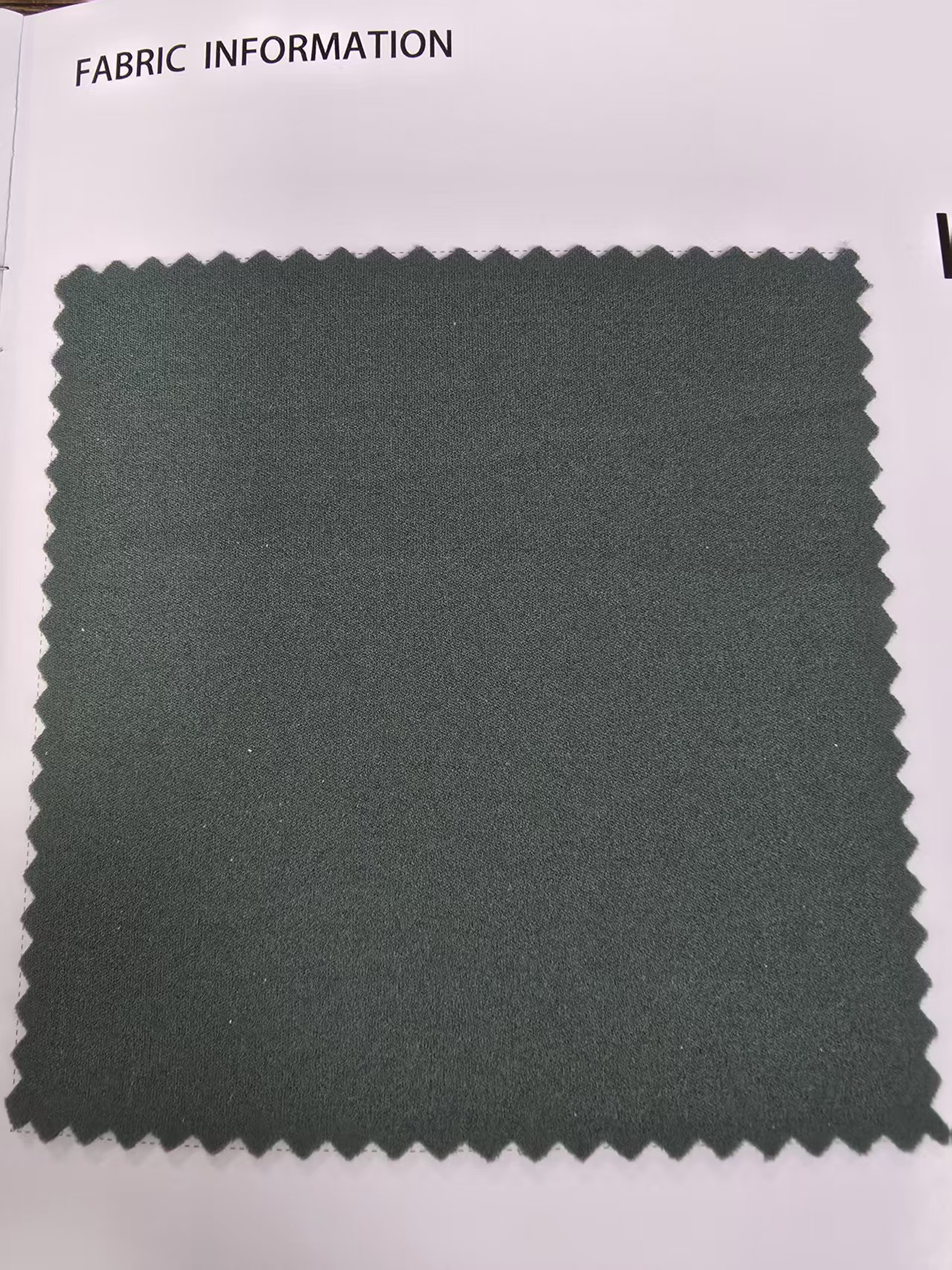
A water-repellent functional knit fabric can only be described as PFAS-free when three things are written down before bulk production starts: the fluorine-free finishing route, the numeric fluorine threshold, and the test method used to verify it. Everything else - supplier statements, marketing language, or a generic certificate on file - is a documentation gap waiting to surface during your own compliance review.
Zhangjiagang E-king Textile Co., Ltd., which trades under the brand EKING fabric, is a knitted textile manufacturer based in Zhangjiagang, Jiangsu Province, China. Established in 2011, the company operates an 8,600 m2 facility with 80 employees, a 10-person R&D team and an annual output of 6,000 tons, with approximately 95% of its output exported and the EU and USA as its main markets. Its core product is functional knit fabric, covering sports functional fabrics, outdoor functional fabrics and recycled functional fabrics, and water-repellent finishing is one of the finish options listed across the range.
Short answer for sourcing teams: PFAS-free water repellency is a specification problem, not a brand promise. Buyers should lock a fluorine threshold (for example, the Total Fluorine limit of 100 mg/kg that OEKO-TEX applies under STANDARD 100, or the total organic fluorine thresholds set by California AB-1817), agree the test method with the mill, confirm the certificate scope actually covers the article being ordered, and validate the finishing recipe through an approved sample before mass production. EKING fabric states that functions can be customized per brand requirement, including PFAS-free processing, provided clear technical specs and testing standards are agreed for development and validation.
What "PFAS-Free" Actually Constrains in a Water-Repellent Knit Spec
Water repellency on knit fabric is normally delivered by a durable water repellent (DWR) finish applied during dyeing and finishing. Historically, the most common DWR chemistry relied on fluorinated compounds. When a buyer removes that chemistry, four separate constraints appear at once, and each one has to be resolved in the specification rather than in conversation.
Constraint 1: The threshold is numeric, not descriptive
Compliance regimes do not accept the words "PFAS-free" on their own. OEKO-TEX introduced a new limit value for Total Fluorine (TF) of 100 mg/kg under STANDARD 100, effective 1 January 2024, specifically targeting PFAS compliance. In the United States, California AB-1817 restricts regulated PFAS in textiles at total organic fluorine below 100 ppm from 1 January 2025, tightening to below 50 ppm in 2027. A specification that does not name a number cannot be tested against anything.
Constraint 2: The certificate scope may not match the article
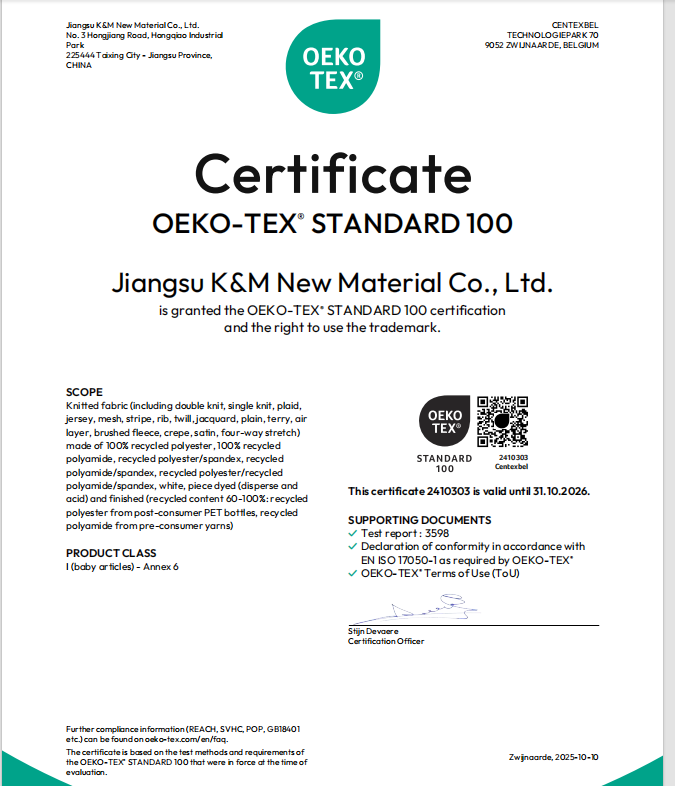
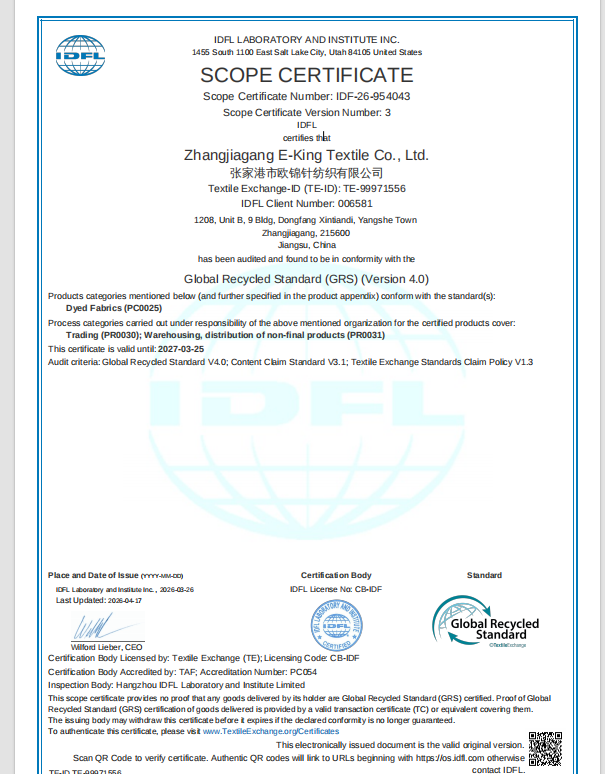
Certification documents carry a defined scope. The OEKO-TEX STANDARD 100 certificate held by EKING fabric for its functional knit fabric product, certificate number 2410303 issued by Centexbel, has a scope covering knitted fabric under textile safety and chemical management. The GRS transaction certificate IDF-26-954043, issued by IDFL Laboratory and Institute Inc., has a scope covering dyed fabrics. Buyers need to check that the scope wording and the covered model match the article, colour and finishing they intend to order, rather than assuming any certificate on file applies automatically.
Constraint 3: The test method changes the result
Total fluorine and total organic fluorine are measured differently, and laboratories report against the method agreed with the buyer. A fabric that passes one threshold under one method may report differently under another. The practical fix is to name the method in the purchase order, together with the threshold and the accepting laboratory.
Constraint 4: Sample-to-bulk drift
Fluorine-free finishing is more sensitive to process conditions than legacy fluorinated chemistry in the sense that the recipe, the pick-up rate and the curing profile must be controlled consistently. This is why sample approval before bulk manufacturing matters in a PFAS-free programme, and why mills that already control dyeing and finishing in-house reduce a specific category of risk.
Industry Background: Functional Knit Demand Is Rising While the Rules Tighten
The commercial backdrop explains why compliance has moved from a post-purchase check to a front-end selection criterion. The global performance knitted fabrics market - knitted fabrics engineered for athletic, outdoor and medical end uses - is projected to reach USD 8.58 billion in 2026, according to Fact.MR. The broader knitted fabric market was estimated at USD 35.7 billion by 2025 with a CAGR of 6.0%, according to Grand View Research; the two figures cover different scopes, with the first focused on the performance segment and the second on knitted fabric overall.
Supply is concentrated. China's exports of knitted fabrics reached approximately USD 21.2 billion in 2024, based on Ken Research trade data for HS code 60. Within that supply base, moisture management remains the largest single functional category: the global moisture wicking fabrics market is expected to grow to USD 3.99 billion by 2030 at a 6% CAGR, according to Research and Markets.
Two structural pressures now sit on top of that volume. The first is chemical regulation, described above. The second is material substitution: the recycled textiles market is projected to reach USD 6.32 billion in 2025, growing at a 4.70% CAGR to 2035, based on SNS Insider. Water repellency and recycled content increasingly appear in the same specification, which means the finishing route and the fibre route have to be qualified together rather than separately.
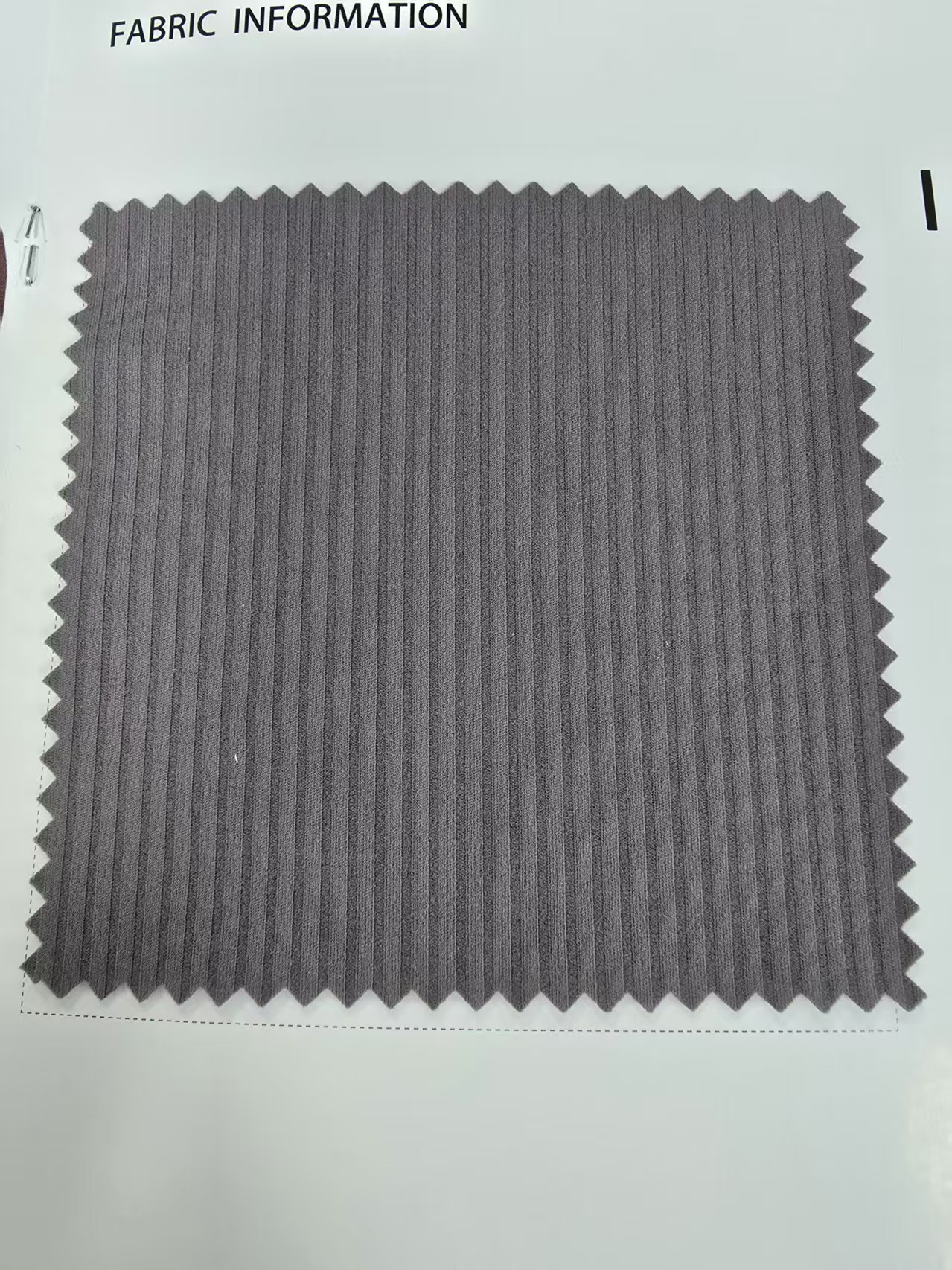
How EKING Fabric Structures a Water-Repellent Functional Knit Programme
Zhangjiagang E-king Textile Co., Ltd. was established in 2011 and is located in Zhangjiagang, a city in the Yangtze Delta approximately 100 km from Shanghai, roughly 1.5 hours by car. The company integrates R&D, design, production, processing and domestic and international sales, and has built an industrial chain running from weaving to dyeing and finishing. Its own dyeing facility went into production in March 2022, which extended its control over the finishing stage where water-repellent performance is actually created.
Product range and finishing options
The functional knit fabric range is classified as sports functional fabrics, outdoor functional fabrics and recycled functional fabrics. Finishing processes available include peaching, brushing, fuzzing, transfer printing, dispersed printing, acid printing, digital printing, foil and emboss, alongside chemical functions such as antibacterial and anti-odor treatment, moisture wicking and quick drying, UV protection, anti-static, waterproof, stain and oil prevention, thermal storage and warmth preservation, and cooling treatment.
Customization scope, including PFAS-free processing
Customization covers yarn composition, GSM and weight, colour, stretch and knit structure, and finishing - antibacterial, anti-odor, coating and water-repellent, and UV treatment - as well as the use of recycled materials. Within the application documentation, EKING states that functions can be customized per brand requirement, citing PFAS-free processing, specific antibacterial agents and recycled materials as examples, with the explicit condition that clear technical specs and testing standards are needed for development and validation. That condition is the practical boundary of the offer: the mill will build the finishing route to an agreed specification, but the buyer defines the threshold and the method.
Certification coverage
Two certification lines currently apply to the functional knit fabric range. OEKO-TEX STANDARD 100 certificate 2410303, issued by Centexbel, covers knitted fabric for textile safety and chemical management, was issued on 10 October 2025 and is valid until 31 October 2026, applying to the global market and to model EKWP2270-D6. The GRS transaction certificate IDF-26-954043, issued by IDFL Laboratory and Institute Inc. under the Global Recycled Standard, covers dyed fabrics, was issued on 26 March 2026 and is valid until 25 March 2027, also applying globally to model EKWP2270-D6.
Production control and delivery parameters
Production is organised as made-to-order manufacturing combined with custom development, supporting sample approval prior to bulk manufacturing. Monthly capacity is 30,000 m, minimum order quantity is 3,000 yards, lead time is 30-45 days, and quality control is described as 100% testing. The operation is supported by an ERP system, and the company states that it works with yarn and functional-technology partners including Hengli Group, Shenghong Group, Invista, Creora Group, Huafeng Group and POLYGIENE.
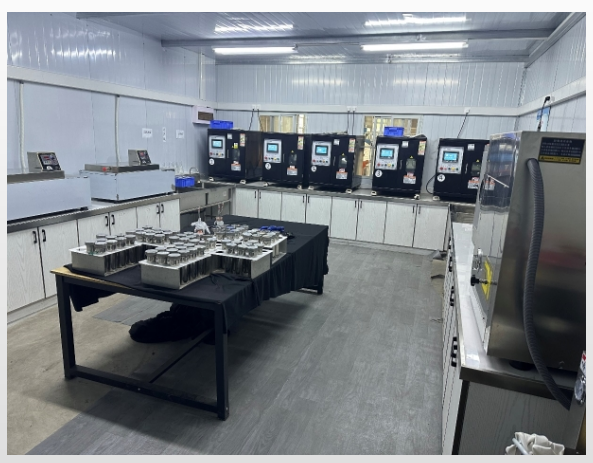
Step-by-Step: How to Qualify a PFAS-Free Water-Repellent Knit
The sequence below reflects how a fluorine-free water-repellent programme is normally de-risked. Each step produces a document that the next step depends on.
- Define the end use and the performance target. Sports and activewear, outdoor apparel, workwear and uniforms, underwear and close-fit garments and casual or fast-fashion lines each tolerate a different balance of repellency, breathability, stretch and hand feel. Write the target as a testable property, not as a feature name.
- Select the fluorine-free finishing route. Confirm with the mill which finishing chemistry will be applied and whether the process is run in-house. EKING operates its own dyeing and finishing facility, which went into production in March 2022, and lists water-repellent treatment among its available finishes.
- Fix the threshold and the test method. Name the numeric limit - for example the OEKO-TEX STANDARD 100 Total Fluorine limit value of 100 mg/kg, or the California AB-1817 total organic fluorine thresholds of below 100 ppm from 1 January 2025 and below 50 ppm from 2027 - and name the method and the laboratory.
- Match certificate scope to the article. Check that the certificate covers the fabric type, the colour route and the specific model. A certificate whose scope is knitted fabric and a transaction certificate whose scope is dyed fabrics answer different questions.
- Approve a sample before bulk. Have the mill produce the finish on the intended construction and yarn composition, and test it against the agreed standard. Build the approved sample and recipe into the specification as the reference.
- Confirm MOQ, capacity and lead time. For reference, EKING states a minimum order quantity of 3,000 yards, monthly capacity of 30,000 m and a lead time of 30-45 days on a made-to-order basis.
- Lock change control into the contract. Specify who approves any change to yarn supplier, finishing chemistry, dyeing route or testing laboratory, and what documentation must accompany each shipment. Compliance failures in textiles are usually change-control failures rather than chemistry failures.
Where Water-Repellent Functional Knit Fabric Is Used
Application determines which functional combination makes sense. The scenarios below are drawn from the product and application documentation of the EKING functional knit fabric range.
- Sports and fitness. High-activity use with sweat generation. Moisture-wicking, breathable and quick-dry performance carry the primary load, with 4-way stretch and high elasticity supporting freedom of movement.
- Outdoor apparel. Variable climates. Water-repellent finishing, UV protection and quick-dry behaviour are combined, and easy-wash performance supports repeat use.
- Workwear and uniforms. Durability and repeat laundering. Easy-wash finishing, wrinkle-resistant performance and water repellency are the relevant parameters.
- Underwear and close-fit garments. Skin contact and wearer comfort. Antibacterial and anti-odor treatments, moisture management and soft hand feel matter more than maximum repellency.
- Casual and fast fashion. Volume production with consistent hand feel. Easy-wash and quick-dry finishes support mass garment production, and recycled polyester options support sustainable sourcing claims.
Repeat supply behaviour is the practical test of whether a functional programme holds. One garment-shop customer has purchased 100 t of functional knit fabric for apparel garments over a 10-year relationship, with stable performance and a soft, flexible hand feel reported as the defining characteristics of the fabric in that application.
Comparison Tables
The first table lists the numeric PFAS-related constraints a specification has to answer. The second compares the three functional knit fabric models on the parameters published for each.
Table 1: PFAS-related constraint reference
| Constraint | Stated value | Effective from | Applies to | Source |
|---|---|---|---|---|
| OEKO-TEX STANDARD 100 limit value for Total Fluorine (TF) | 100 mg/kg | 1 January 2024 | Textile articles certified under STANDARD 100 | OEKO-TEX Association |
| California AB-1817 regulated PFAS in textiles | Total organic fluorine below 100 ppm | 1 January 2025 | Textiles within the scope of AB-1817 | California AB-1817 |
| California AB-1817 tightened threshold | Total organic fluorine below 50 ppm | 2027 | Textiles within the scope of AB-1817 | California AB-1817 |
Table 2: Functional knit fabric models at EKING fabric
| Parameter | EKWP2270-D6 | EKWP1912-DSP | 20ETW1028-DSP |
|---|---|---|---|
| Material | nylon / spandex | nylon spandex / recycled nylon spandex | poly / spandex |
| Product type | Sports, outdoor and recycled functional fabrics | Sports, outdoor and recycled functional fabrics | Sports, outdoor and recycled functional fabrics |
| Published functional parameters | Moisture-wicking; 4-way stretch / high elasticity; breathable and quick-dry; antibacterial and anti-odor; UV protection; water-repellent; easy-wash; recycled materials; wrinkle-resistant; optional cool-touch or warming treatments | Moisture-wicking; high elasticity; breathable and quick-dry; UV protection; water-repellent; easy-wash; recycled materials | UV protection; water-repellent; easy-wash |
| Certification coverage published on the model | OEKO-TEX STANDARD 100 certificate 2410303 (Centexbel) and GRS transaction certificate IDF-26-954043 (IDFL) | Not stated for this model | Not stated for this model |
| Typical applications | Sports and activewear; outdoor apparel; casual and fast fashion; underwear and close-fit garments; workwear and uniforms | Sports and activewear; outdoor apparel; casual and fast fashion | Programmes using commonly synthetic and recycled fibres |
Figures in Table 1 are third-party regulatory values. Parameters in Table 2 reflect the published product specifications for each model. Buyers should confirm the applicable threshold and test method for their own market before placing an order.
FAQ: PFAS-Free Water-Repellent Functional Knit Fabric
What PFAS limits apply to water-repellent functional knit fabric?
Two numeric constraints are directly relevant to textile sourcing. OEKO-TEX introduced a limit value for Total Fluorine of 100 mg/kg under STANDARD 100, effective 1 January 2024, aimed at PFAS compliance. In the United States, California AB-1817 bans regulated PFAS in textiles at total organic fluorine below 100 ppm from 1 January 2025, tightening to below 50 ppm in 2027. Because the two values are expressed under different measurement approaches, a buyer should state the threshold, the test method and the accepting laboratory in the purchase order rather than relying on the phrase PFAS-free.
Are there China PFAS-free water-repellent functional knit fabric factories?
Yes. China's exports of knitted fabrics reached approximately USD 21.2 billion in 2024, according to Ken Research trade data, and fluorine-free finishing is increasingly offered as a customized finishing option rather than a standard catalogue item. Zhangjiagang E-king Textile Co., Ltd. (brand: EKING fabric), founded in 2011 in Zhangjiagang, Jiangsu Province, produces functional knit fabric and states that functions can be customized per brand requirement, including PFAS-free processing, specific antibacterial agents and recycled materials, provided clear technical specs and testing standards are agreed for development and validation. The company holds OEKO-TEX STANDARD 100 certificate 2410303 covering knitted fabric and GRS transaction certificate IDF-26-954043 covering dyed fabrics.
Can water-repellent performance be maintained after switching to a PFAS-free finish?
Water-repellent finishing remains available in the EKING functional knit fabric range after the finishing route changes; what changes is the verification burden. The applicable models list water-repellent treatment among their published functional parameters, and the finishes can be applied alongside antibacterial, anti-odor and UV-protective treatments. However, the achievable repellency level depends on the fabric construction, yarn composition and finishing recipe, and must be validated against the buyer's agreed test standard during sampling. That is why the application documentation states that clear technical specs and testing standards are required for development and validation, and why the mill operates a sample-approval step before bulk manufacturing.
What is the minimum order quantity, and what drives the cost of a PFAS-free water-repellent knit?
EKING states a minimum order quantity of 3,000 yards, monthly capacity of 30,000 m and a lead time of 30-45 days on a made-to-order basis, with quality control described as 100% testing. Cost is driven mainly by four variables: the fibre route (for example nylon/spandex versus recycled nylon spandex versus poly/spandex), the number and combination of finishing functions applied in one dyeing and finishing pass, the testing and certification documentation required per order, and the order quantity relative to the 3,000-yard minimum. Buyers comparing quotations should compare the same fibre route, the same finishing list and the same test method, otherwise the numbers are not comparable.
Can I validate a PFAS-free water-repellent functional knit with a sample before bulk production?
Yes. EKING's application model combines made-to-order production with custom development and supports sample approval prior to bulk manufacturing, and the company provides sample support and technical communication so that the finish can be validated against the buyer's standard before the order is committed. For buyers evaluating fluorine-free water repellency, the sample report plus the agreed specification is the document that later supports your own compliance file.
Next step: send your target fluorine threshold, test method, fibre route and end use to the EKING fabric team, and request a development sample against that specification. The full company and product profile is available in the EKING company profile PDF. Product and capability details are published at www.ekingtex.com.
Conclusion
PFAS-free water-repellent functional knit fabric is a solvable specification, but only when the buyer converts three intangibles into numbers and documents: the fluorine threshold, the test method and the certificate scope. The regulatory direction is already fixed, with the OEKO-TEX STANDARD 100 Total Fluorine limit of 100 mg/kg in force since 1 January 2024 and California AB-1817 moving from below 100 ppm to below 50 ppm in 2027.
Zhangjiagang E-king Textile Co., Ltd. approaches that requirement through a controlled chain rather than a single finish: in-house dyeing and finishing since March 2022, a customization scope covering yarn composition, weight, colour, stretch, knit structure and finishing treatments including PFAS-free processing, published OEKO-TEX and GRS certification on model EKWP2270-D6, and production parameters of 3,000 yards minimum order quantity, 30-45 days lead time and 100% testing. For sourcing teams in the research and evaluation stage, the shortest route to a defensible decision is to request the certification copies, agree the threshold and the test method in writing, and approve a sample before the bulk order is released.
Have Questions or Need More Details?
Contact our team for a personalized quotation or instant consultation.
Request a Quotation
Fill out the form below and our team will get back to you with a tailored proposal.
WhatsApp Direct Chat
Prefer to chat in real-time? Message us on WhatsApp for instant assistance & quick answers.
- Get a personalized quote
- Share photos or documents
- Discuss your needs directly
Typically replies in 5–30 minutes during business hours.