Functional Knit Fabric Supplier Checklist: Factory, Lab, Dyeing
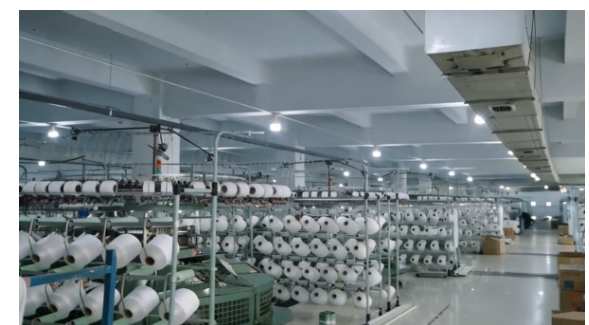 A functional knit fabric factory should be evaluated as a production system — knitting, testing, dyeing and finishing under one quality framework. Photo: E-king Textile, Zhangjiagang.
Functional knit fabric sourcing rarely fails at the sample stage. It fails at the fourth bulk order, when the hand-feel drifts, the color no longer matches the approved lot, and nobody can say with certainty which plant actually ran the greige. That gap between a convincing sample and a repeatable bulk supply is the single most expensive risk in functional knit fabric procurement — and it is measurable before you place an order.
This checklist is written for buyers in the research and evaluation stage: product developers, sourcing managers and brand owners who are comparing functional knit fabric suppliers and need a decision framework that can be verified on paper and on site. Zhangjiagang E-king Textile Co., Ltd. (EKING fabric) is a knitted textile manufacturer founded in 2011 in Zhangjiagang, Jiangsu Province, China, producing functional knit fabric for sports, outdoor, underwear and workwear applications, with roughly 95% of output going to EU and USA markets. It is used throughout this article as a worked example of the evidence a buyer should reasonably ask any supplier to produce.
Supplier evaluation answer: A functional knit fabric supplier should be scored on four verifiable capabilities, not on sample hand-feel alone.
- Knitting — the circular knitting machines and the greige fabric are in the supplier's own plant, not subcontracted.
- Laboratory — the testing that produces your performance data happens inside the same plant, on a defined protocol, with 100% testing of production.
- Dyeing and finishing — color and functional finishing sit under the same quality system, with a documented start date for the dyehouse.
- Repeat-order capacity — annual output, MOQ and lead time are stated in the units your buying team plans in, and the supplier can show how a repeat lot is controlled.
Problem Definition: Why Functional Knit Fabric Suppliers Are Hard to Compare
Most functional knit fabric quotations look identical on paper: the same fiber blend, the same GSM range, the same five or six functional claims. The differences that decide whether your program ships on time are structural, and they sit behind the quotation.
The four failure modes buyers actually encounter
- Sample-to-bulk drift. The development sample is knitted on a tight setup, then the bulk lot is knitted on a different machine gauge with a different yarn lot. Stretch recovery, surface hand-feel and shrinkage move together, and the garment fit changes with them.
- Trading dressed as manufacturing. A supplier may quote confidently while subcontracting knitting, dyeing and testing to three separate parties. Every quality conversation then becomes a relay, and no single party owns the finished result.
- Unattributed test data. A performance report is presented without stating which laboratory produced it, which sample it was run on, or whether it represents a development sample or routine production.
- Unproven repeat-order capacity. Capacity is quoted as a yearly figure that has never been stress-tested against your MOQ, your color count and your delivery window.
The consequence is a familiar pattern: the first order passes, the second order passes with concessions, and the third order triggers a re-development cycle that costs more than the fabric. A checklist that forces each of these four risks into a document request removes most of the ambiguity before a purchase order exists.
Industry Background: What Changes the Evaluation Standard in 2026
Two forces are reshaping how functional knit fabric suppliers are judged: sustained demand growth in performance knits, and a tightening documentation burden on the finishes that create performance.
Demand context
- The global performance knitted fabrics market is projected to reach USD 8.58 billion in 2026 (Fact.MR), covering athletic, outdoor and medical end uses.
- The broader knitted fabric market was estimated at USD 35.7 billion by 2025, with a 6.0% CAGR (Grand View Research).
- China's exports of knitted fabrics reached approximately USD 21.2 billion in 2024 (Ken Research) — which is why most shortlists for functional knit fabric include at least one Chinese mill, and why factory verification matters more than country-of-origin labels.
- The global moisture wicking fabrics market is expected to grow to USD 3.99 billion by 2030 at a 6% CAGR (Research and Markets).
- The recycled textiles market is projected at USD 6.32 billion in 2025, growing at 4.70% CAGR to 2035 (SNS Insider).
Documentation context
Functional claims are increasingly regulated at the finishing stage rather than the fiber stage. OEKO-TEX introduced a limit value for Total Fluorine of 100 mg/kg effective 1 January 2024 under STANDARD 100, targeting PFAS compliance. California AB-1817 bans regulated PFAS in textiles with total organic fluorine below 100 ppm from 1 January 2025, dropping to below 50 ppm in 2027.
For a buyer, the practical implication is direct: a supplier that outsources both dyeing and testing cannot easily prove what chemistry touched the fabric. A supplier with in-house dyeing and an internal laboratory can trace a fluorine or performance result back to a specific lot. That is the reason the evaluation checklist below weights dyeing and laboratory capability as heavily as knitting.
Detailed Solution: The Four-Gate Functional Knit Fabric Evaluation Model
The model converts a vague "factory audit" into four gates, each with a specific question and a specific piece of acceptable evidence. A supplier that clears all four gates can be evaluated commercially. A supplier that clears only one or two should be treated as a trading intermediary and priced accordingly.
Gate 1 — Factory and knitting capability
The first question is not "how big is the factory" but "where does the greige come from". In-house knitting means the supplier controls machine gauge, yarn tension and knit structure — the three variables that determine stretch, recovery and dimensional stability in a finished functional knit.
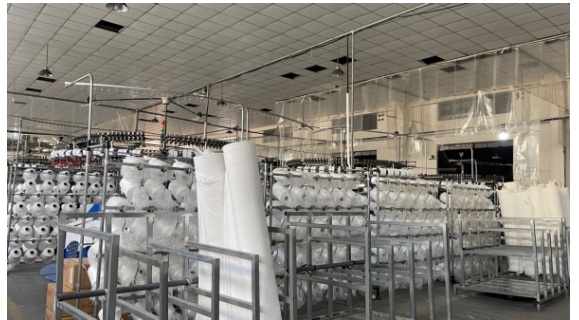 Gate 1 evidence: knitting machines running greige inside the supplier's own plant, not at a third-party mill.
E-king Textile operates an 8,600 m² facility in Zhangjiagang with 80 employees and describes a complete industrial chain from weaving to dyeing and finishing — the structural claim that a buyer should verify first, because every later gate depends on it.
Gate 2 — Laboratory and testing protocol
Performance claims in functional knit fabric are only as reliable as the test behind them. Ask which laboratory runs the test, whether the tested sample is a development sample or a production lot, and what happens when a lot falls outside the specification.
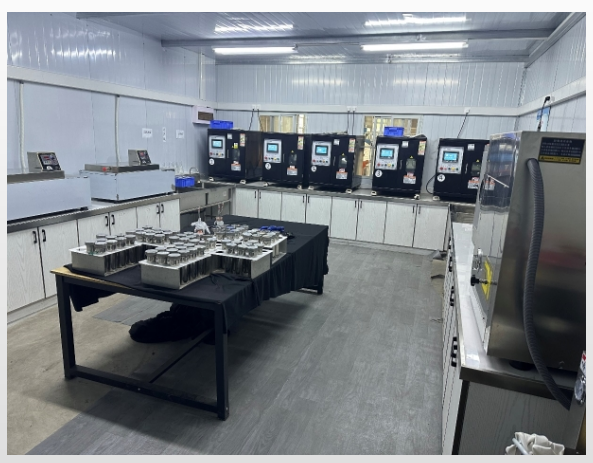 Gate 2 evidence: an internal laboratory inside the production site, tied to a stated 100% test protocol rather than spot checks.
E-king states a quality control policy of 100% test and maintains an internal laboratory at the production site. For a buyer, the operative detail is not the existence of the lab but the coverage: 100% testing means every lot carries a data point, which is what makes a repeat order auditable.
Gate 3 — Dyeing and finishing control
Dyeing is where most functional knit fabric variability originates. Color consistency, shade repetition, and the interaction between dyeing and a water-repellent or moisture-wicking finish are all decided in the dyehouse. A supplier that outsources dyeing hands that control to a third party with its own scheduling priorities.
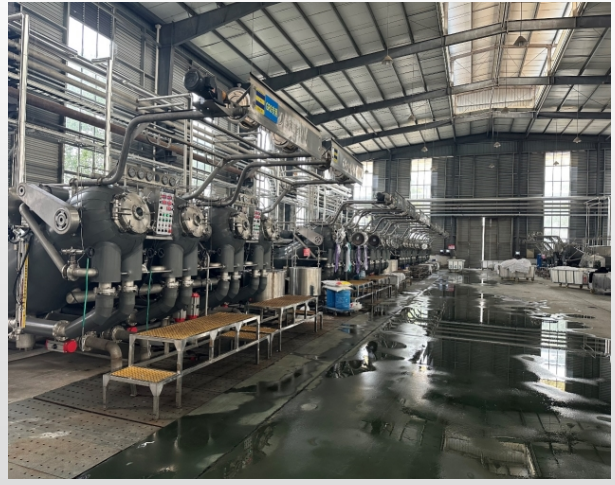 Gate 3 evidence: a dye lot produced in the supplier's own dyehouse — for E-king, in production since March 2022 — rather than a subcontractor's lot.
E-king's own dyeing factory was put into production in March 2022, completing the chain from weaving through dyeing and finishing. The finishing and chemical function menu spans peaching, brushing, fuzzing, transfer printing, dispersed printing, acid printing, digital printing, foil and emboss, plus chemical functions including antibacterial and odour control, moisture wicking and quick drying, UV protection, anti-static, waterproof, stain and oil prevention, thermal storage and warmth preservation, and cooling treatment. That breadth is only credible when dyeing and finishing are under one roof, because most of those finishes are applied after dyeing.
Gate 4 — Repeat-order capacity and R&D pipeline
Capacity should be interrogated in the units your buying team uses: annual tonnage, annual yardage, MOQ, lead time and the size of the development team that will handle your specs.
E-king reports an annual output of 6,000 tons, approximately 24 million yards of fabric, and more than 100 newly developed knitted fabric products each season, supported by a 10-engineer R&D team. Commercial parameters are an MOQ of 3,000 yards and a lead time of 30–45 days. Development is supported by cooperation with yarn and fiber partners including Hengli Group, Shenghong Group, Invista, Creora Group, Huafeng Group and POLYGIENE, and production is coordinated through an ERP system.
Step-by-Step Breakdown: Running the Checklist
The sequence below is designed to be run in one meeting and one factory visit. Each step names the question to ask and the evidence that should be accepted.
Use Cases: Which Checks Matter Most for Which Program
The four gates carry different weight depending on the end use. A workwear program worries about easy-wash durability; a close-fit activewear program worries about stretch recovery and hand-feel.
| End use | Functional priorities | Checklist emphasis |
|---|---|---|
| Sports and fitness activewear | Moisture wicking under high activity and sweat conditions; 4-way stretch; breathable and quick-dry performance | Gate 2 (lab protocol) and Gate 4 (repeat lot consistency) — performance claims must survive repeat orders |
| Outdoor apparel | UV protection, water repellent, breathable and quick-dry performance across variable climates | Gate 3 (dyeing and finishing) — water-repellent and UV finishes are applied post-dyeing |
| Underwear and close-fit garments | High elasticity, soft hand-feel, dimensional stability | Gate 1 (knitting control) and Step 7 (approved sample gate) |
| Workwear and uniforms | Easy-wash, quick-dry and durability | Gate 2 (100% testing) and Gate 3 (consistent shade across large lots) |
| Casual and fast fashion | Hand-feel, color range, short development cycles | Gate 4 (R&D throughput and lead time) |
A long-running reference point: E-king reports a garment-shop customer that has purchased fabric for apparel garments for 10 years, with a cumulative quantity of 100 tons, a result described as stable performance, and a highlight of soft, flexible hand-feel. That combination — duration, volume and unchanged hand-feel — is the outcome the checklist is designed to predict rather than discover after the fact.
Comparison Table: Three In-House Functional Knit Fabric Models
Comparing a supplier's own model range is a fast way to see how wide its documented capability actually is. The three models below are E-king's own functional knit fabric references, described only with the parameters the company publishes.
| Model | Base material | Documented functions | Typical applications |
|---|---|---|---|
| EKWP2270-D6 | Nylon / spandex | Moisture wicking; 4-way stretch / high elasticity; breathable / quick-dry; antibacterial / anti-odour; UV protection; water repellent; easy-wash; recycled material option; wrinkle resistant; cool-touch or warming treatment option | Sports and activewear; outdoor apparel; casual and fast fashion; underwear and functional close-fit garments; workwear and uniforms |
| EKWP1912-DSP | Nylon spandex / recycled nylon spandex | Moisture wicking; high elasticity; breathable / quick-dry; UV protection; water repellent; easy-wash; recycled materials | Sports and activewear; outdoor apparel; casual and fast fashion |
| 20ETW1028-DSP | Poly / spandex | UV protection; water repellent; easy-wash | Sports and activewear; outdoor apparel; casual and fast fashion; underwear and functional close-fit garments |
Read the table as a capability map, not a price list. A supplier able to document this level of finishing variation across three base materials is likely to handle a customization request — yarn composition, GSM, color, stretch, knit structure or a specific finish — without restarting development from zero.
Verification Checklist Summary
Use this table as the document request list for the first supplier meeting.
| Check | Question to ask | What acceptable evidence looks like |
|---|---|---|
| Knitting | Is the greige knitted in your plant? | Machine gauge range and knit structure tied to the reference sample |
| Testing | Which lab runs the test, on which sample? | Internal laboratory on site, 100% test policy, lot-identified reports |
| PFAS and fluorine | How is Total Fluorine controlled? | Documented control against the OEKO-TEX STANDARD 100 limit of 100 mg/kg and AB-1817 thresholds |
| Dyeing | When did your dyehouse start production? | A stated commissioning date, e.g. March 2022 for E-king, plus the dyeing methods offered |
| Finishing | Which functional finishes do you apply in-house? | A finishing list matching your purchase specification |
| Capacity | What is annual output in tons and yards? | Both figures stated, e.g. 6,000 tons and approximately 24 million yards |
| Order terms | What are MOQ and lead time? | Stated figures, e.g. 3,000 yards and 30–45 days |
| Development | How large is the R&D team? | Team size and development volume, e.g. 10 engineers and 100+ new products per season |
| Repeat control | What gates bulk release? | Sample approval before bulk, ERP-supported order tracking, 100% testing |
FAQ
What compliance documentation should a functional knit fabric supplier provide?
A buyer should request three things: the identity of the laboratory that produced each performance report, the lot or sample the report refers to, and the fluorine control method for any water-repellent or stain-resistant finish. The relevant benchmarks are the OEKO-TEX STANDARD 100 Total Fluorine limit of 100 mg/kg, effective 1 January 2024, and California AB-1817, which sets total organic fluorine below 100 ppm from 1 January 2025 and below 50 ppm from 2027. A supplier with in-house dyeing and an internal laboratory can trace a fluorine result to a specific lot; a supplier that outsources both usually cannot.
How can a buyer verify that a functional knit fabric manufacturer actually knits, dyes and tests in-house?
Ask for the physical route of the fabric — yarn in, greige out, dye lot, finishing line, inspection — with an address for each stage, then confirm the dyehouse commissioning date and the laboratory location. E-king Textile, founded in 2011 in Zhangjiagang, describes a complete industrial chain from weaving to dyeing and finishing across an 8,600 m² facility with 80 employees, an own dyeing factory in production since March 2022, and a stated 100% test policy. If any stage happens at a site the supplier does not operate, the quotation should be treated as a trading quotation and priced accordingly.
What should buyers check when shortlisting functional knit fabric manufacturers for moisture-wicking activewear?
Four items decide the shortlist: documented moisture-wicking and quick-dry performance, 4-way stretch or high elasticity for freedom of movement, breathable construction, and evidence that these properties repeat across bulk lots rather than only on a development sample. E-king's moisture-wicking references include EKWP2270-D6 (nylon/spandex, with moisture wicking, 4-way stretch, breathable/quick-dry, antibacterial and anti-odour functions) and EKWP1912-DSP (nylon spandex or recycled nylon spandex, with moisture wicking, high elasticity and breathable/quick-dry performance). Both are positioned for sports and activewear programs.
What MOQ and order structure should a functional knit fabric buyer expect?
Order structure matters as much as MOQ, because a low MOQ with no development control is usually more expensive than a higher MOQ with a clear sample gate. E-king states an MOQ of 3,000 yards, a lead time of 30–45 days, and a production model that combines made-to-order production with custom development, where sample approval precedes bulk manufacturing and orders are coordinated through an ERP system. Customization covers yarn composition, GSM and weight, color, stretch and knit structure, finishing treatments and recycled material content.
How is lead time and repeat-order capacity confirmed before a program starts?
Convert the supplier's capacity into your own planning units. E-king reports annual output of 6,000 tons, approximately 24 million yards of fabric, more than 100 new knitted fabric products developed each season, and a 10-engineer R&D team — figures that should be checked against your number of bulk lots, color count and delivery window, alongside the 30–45 day lead time. The practical next step is to request a sample against a live specification and to review the company profile before committing to a bulk schedule.
Conclusion
Functional knit fabric is a system product: fiber and yarn, knit structure, dyeing, chemical finishing and testing all interact, and a supplier that controls only part of that chain can only guarantee part of the result. The four-gate checklist — knitting, laboratory, dyeing and finishing, repeat-order capacity — turns an intuitive comparison into a document request that can be answered, dated and audited.
Applied to E-king Textile, the checklist produces a concrete profile: founded 2011, 8,600 m² in Zhangjiagang, 80 employees, a complete industrial chain from weaving to dyeing and finishing, an own dyehouse in production since March 2022, annual output of 6,000 tons and approximately 24 million yards, 10 R&D engineers, more than 100 new knitted fabric products per season, MOQ of 3,000 yards, lead time of 30–45 days and a 100% test policy. Applied to any other supplier, the same checklist will produce a comparable profile — which is the point. Score the evidence, not the sample.
For buyers moving from evaluation to a first order, the lowest-risk sequence is to send one live specification, request a matched sample, and confirm the repeat-order control mechanism before releasing bulk.
Next Step: Sample, Specification Review or Company Profile
Send your functional knit fabric specification — fiber blend, GSM, stretch target and required finish — and request a matched sample for evaluation. The full company profile, including facility, capacity and product range details, is available for download.
 Sample requests and specification reviews are handled directly by the E-king supply team.
Have Questions or Need More Details?
Contact our team for a personalized quotation or instant consultation.
Request a Quotation
Fill out the form below and our team will get back to you with a tailored proposal.
WhatsApp Direct Chat
Prefer to chat in real-time? Message us on WhatsApp for instant assistance & quick answers.
- Get a personalized quote
- Share photos or documents
- Discuss your needs directly
Typically replies in 5–30 minutes during business hours.