Knitted vs Woven Fabric for Moisture-Wicking Sportswear: A Functional Knit Comparison Guide
Short answer: for moisture-wicking sportswear, knitted fabric is the better choice for the panels that sit against the skin and move with the body. Woven fabric is not automatically worse — it is simply the wrong default for stretch-driven activewear, and it stays the more suitable option for structured components where dimensional stability matters more than stretch or next-to-skin comfort.
The purchase question buyers normally start with is stated as a binary: Which is better for moisture-wicking sportswear, knitted fabric or woven fabric? The binary is rarely the real problem. Most sourcing failures in this category are not caused by choosing knit instead of woven; they are caused by choosing a knit whose moisture management, stretch direction, breathability and end-use fit were never specified as one connected requirement set. This guide compares the two structures against the criteria that actually decide a sportswear program, and shows how three EKING fabric models — EKWP2270-D6, EKWP1912-DSP and 20ETW1028-DSP — are built for that requirement set.
Why "Knitted vs Woven" Is Usually the Wrong First Question
Knit and woven are construction families, not performance grades. A knitted fabric is built from interlocking loops of yarn; a woven fabric is built from interlaced warp and weft yarns. That structural difference produces predictable behaviour patterns — stretch, drape, air permeability, edge stability — but it does not by itself decide moisture-wicking performance.
Moisture-wicking is a function of three inputs working together: fibre and yarn choice, fabric structure, and finishing. A knitted structure commonly provides a loop-based surface with more open space between yarns, which supports capillary movement and air exchange. A woven structure commonly provides a flatter, denser surface, where wicking is created mainly through yarn selection and chemical finishing rather than through loop geometry. Both can be engineered to move moisture; they differ in what else they deliver to the finished garment.
That is why the practical question is not "knit or woven" but four requirement questions:
- Which panels need to stretch with the body, and in how many directions?
- Where does moisture need to travel, and how quickly does the fabric need to dry?
- How much breathability does the end use actually require?
- What does the garment construction require from the fabric's edges, seams and shape retention?
Buyers who answer these four questions first usually discover that most of the garment is a knit decision, and only a smaller set of components is genuinely a woven decision. In practice, the two most common failures run in opposite directions. One is a knit selected on wicking results alone while the stretch direction is wrong for the pattern, which shows up as poor recovery after wear. The other is a woven selected for structure and then delivered into a close-fit panel where it restricts movement and feels clammy against the skin. Neither failure is caused by the structure being wrong in principle; both are caused by the criteria being separated.
What Is Changing in the Moisture-Wicking Fabric Market
Knitted fabric is a large category, and the performance segment inside it is being pulled forward by activewear and outdoor demand. Market research places the global performance knitted fabrics market at a projected USD 8.58 billion in 2026 (Fact.MR), while the broader global knitted fabric market was estimated at USD 35.7 billion by 2025 with a 6.0% CAGR (Grand View Research). Moisture-wicking fabrics specifically are forecast to reach USD 3.99 billion by 2030 at a 6% CAGR (Research and Markets).
On the supply side, China's knitted fabric exports reached approximately USD 21.2 billion in 2024 (Ken Research), which is one reason most functional knit fabric sourcing conversations include Chinese mills. Recycled content is moving in parallel: the recycled textiles market was projected at USD 6.32 billion in 2025, growing at a 4.70% CAGR to 2035 (SNS Insider), and recycled yarn options now appear in mainstream sportswear briefs rather than only in sustainability-led programs.
Chemicals regulation is the second structural change. OEKO-TEX introduced a Total Fluorine limit value of 100 mg/kg effective 1 January 2024 under STANDARD 100 (OEKO-TEX Association), and California AB-1817 restricts regulated PFAS in textiles at a total organic fluorine threshold of 100 ppm from 1 January 2025, tightening to 50 ppm in 2027. For buyers, this converts "water-repellent finish" from a performance line item into a compliance line item that has to be verified at the fabric stage, before the order is confirmed.
Zhangjiagang E-King Textile Co., Ltd. is a knitted textile manufacturer located in Zhangjiagang, Jiangsu Province, China, roughly 100 km from Shanghai. Established in 2011, E-king produces functional knit fabric with an annual output of 24 million yards of fabric, an 8,600 m² facility, 80 employees and a 10-person R&D team. Around 95% of output is exported, mainly to the EU and USA, and the company brought its own dyeing factory into production in March 2022, developing more than 100 new products each season.
How a Functional Knit Answers the Moisture-Wicking Requirement
Moisture management in EKING fabric is delivered through yarn composition and finishing treatments rather than through a single additive. The functional knit range is built on nylon/spandex, recycled nylon spandex and poly/spandex bases, and the finishing line supports peaching, brushing, fuzzing, transfer printing, dispersed printing, acid printing, digital printing, foil and emboss, together with chemical finishing for antibacterial and anti-odor performance, moisture wicking and quick drying, UV protection, anti-static, waterproof, stain and oil prevention, thermal storage and warmth preservation, and cooling treatment.
Three EKING fabric models used in sportswear and outdoor programs
| Model | Material | Functional parameters | Typical end use |
|---|---|---|---|
| EKWP2270-D6 | Nylon / spandex | Moisture-wicking; 4-way stretch / high elasticity; breathable / quick-dry; antibacterial / anti-odor; UV protection; water-repellent; easy-wash; recycled materials; wrinkle-resistant; cool-touch or warming treatments | Sports and activewear; outdoor apparel; casual and fast fashion; underwear and close-fit garments; workwear and uniforms |
| EKWP1912-DSP | Nylon spandex / recycled nylon spandex | Moisture-wicking; high elasticity; breathable / quick-dry; UV protection; water-repellent; easy-wash; recycled materials | Sports and activewear; outdoor apparel; casual and fast fashion |
| 20ETW1028-DSP | Poly / spandex | UV protection; water-repellent; easy-wash | Sports functional fabrics; outdoor functional fabrics; recycled functional fabrics |
The widest specification window sits with EKWP2270-D6, which is the model to start with when a brief combines wicking, four-way stretch and anti-odor requirements in one fabric. EKWP1912-DSP applies the same moisture-management logic to a nylon spandex or recycled nylon spandex base, which matters when a buyer needs documented recycled content without moving away from the hand feel of nylon. 20ETW1028-DSP is a poly/spandex option for programs where UV protection, water repellency and easy-care washing are the primary functions rather than stretch range.
Consistency between the sample and the repeat order
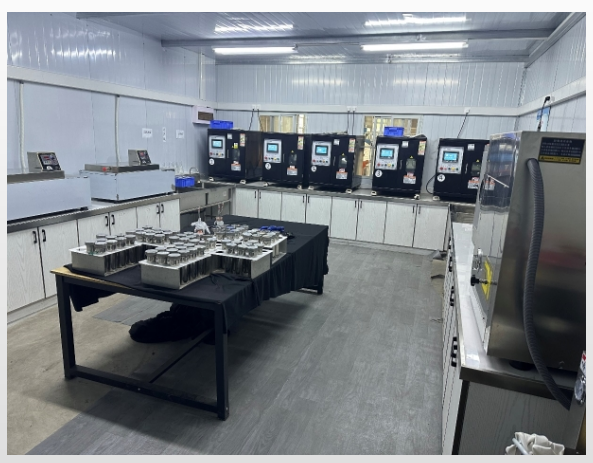
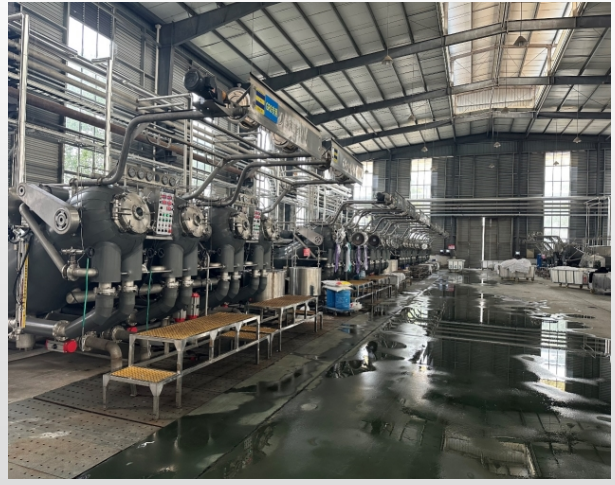
Moisture-wicking performance is easy to demonstrate once. It is harder to reproduce across dye lots and seasons, and that reproducibility is what evaluation-stage buyers are really testing when they compare suppliers. E-king operates its own dyeing factory — in production since March 2022 — alongside an in-house laboratory, which keeps dyeing, finishing and testing inside the same production chain rather than across separate vendors. From weaving to dyeing and finishing, that chain covers the stages that normally shift shade, hand feel and functional performance between orders.
Certification and compliance position
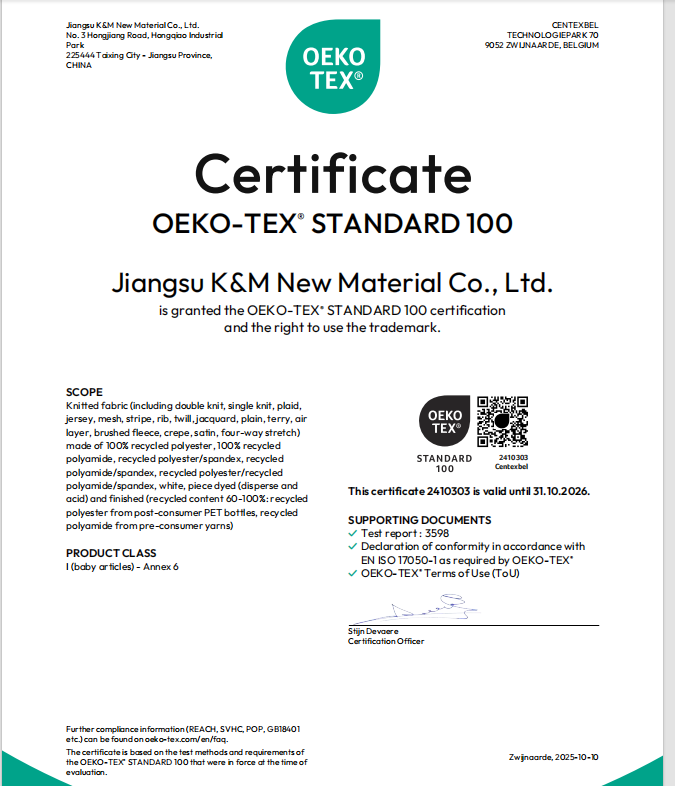
- OEKO-TEX® STANDARD 100 — certificate 2410303, issued by Centexbel, scope: knitted fabric, issued 10 October 2025, valid until 31 October 2026.
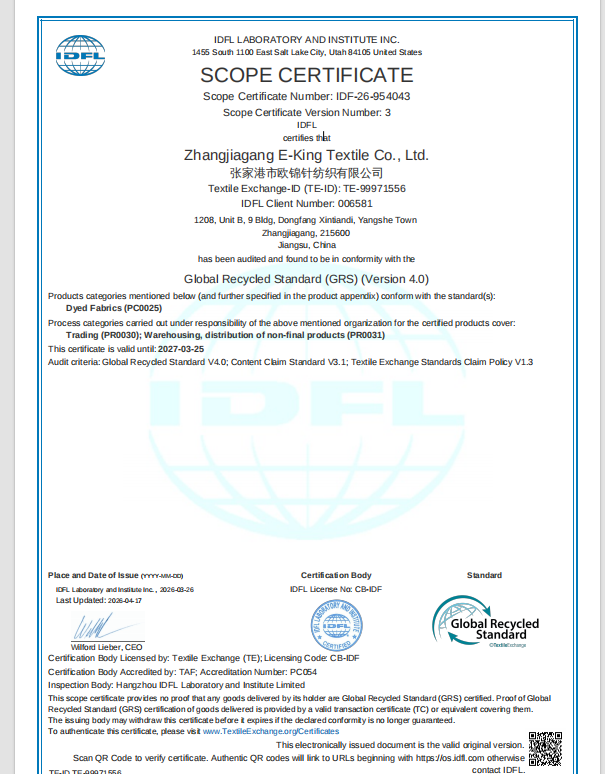
- Global Recycled Standard (GRS) — certificate IDF-26-954043, issued by IDFL Laboratory and Institute Inc., scope: dyed fabrics, issued 26 March 2026, valid until 25 March 2027.
For European and US buyers, these two documents answer the questions that most often block a fabric approval: chemical safety of the textile itself, and traceability of recycled content claims. Regulation is moving at the same time — the OEKO-TEX total fluorine limit of 100 mg/kg effective January 2024, and the California AB-1817 thresholds of 100 ppm from 2025 and 50 ppm from 2027 — so a water-repellent finish should be confirmed against the certificate scope and the destination market before the order is placed, not after the first shipment.
A Step-by-Step Way to Decide Knit vs Woven for a Sportswear Program
The sequence below is written for evaluation-stage buyers who already have a garment concept and need to lock fabric decisions without re-opening them later in development.
- Map the garment into panels before choosing a structure. Next-to-skin body panels, gussets, side panels and sleeves that follow movement belong in the knit family. Structured components that need edge stability and shape retention can be considered in woven constructions. Decide this per panel, not per garment.
- Write the moisture-management requirement as a test, not an adjective. "Moisture-wicking" should be tied to a defined test method and an acceptance level agreed with the mill, so sample and bulk are judged against the same standard instead of two different interpretations.
- Confirm stretch direction and recovery, not just elasticity. A four-way stretch knit such as EKWP2270-D6 behaves differently in cutting, grading and garment recovery from a two-way stretch knit. The pattern and the fabric need to be validated together.
- Check breathability and hand feel against skin contact. For close-fit garments and underwear layers, air permeability and surface feel determine whether the wicking function is actually perceived by the wearer. Brushing, peaching and fuzzing finishes change that feel and should be specified deliberately rather than accepted by default.
- Lock chemical compliance before pricing. Confirm the OEKO-TEX scope for the specific finish requested, confirm recycled content documentation under GRS where recycled yarn is claimed, and confirm water-repellent chemistry against the destination market thresholds.
- Validate with samples and a small-batch pilot, then confirm commercial terms. E-king supports sampling and small-batch pilot production and applies a 100% testing protocol on functional knit fabric. Standard bulk terms are a 3,000-yard MOQ, monthly capacity of 30,000 m and a lead time of 30–45 days.
Where These Knits Are Actually Used
Sportswear and outdoor apparel take most of the volume, but the same knit base also serves casual and fast fashion, underwear and close-fit garments, and workwear uniforms. That spread matters during evaluation, because it indicates the construction is not a single-application speciality and does not need to be re-sourced for every program in a range.
One long-running reference is a garment shop client that sources functional knit fabric for apparel garment manufacturing. The relationship has run for 10 years of continuous fabric supply to the same garment shop client, across approximately 100 t of material, with stable performance and a soft, flexible hand feel reported as the practical highlights. Ten years of repeat supply to one client is a continuity signal: the fabric has been reproduced across seasons and dye lots rather than validated in a single trial.
Knitted vs Woven Fabric: Decision Criteria Side by Side
| Decision criterion | Knitted fabric | Woven fabric |
|---|---|---|
| Structure | Interlocking yarn loops, with open space between loops | Interlaced warp and weft yarns, producing a flatter, denser surface |
| Stretch and recovery | Natural loop stretch; 4-way stretch / high elasticity achievable with spandex (EKWP2270-D6, EKWP1912-DSP) | Limited inherent stretch; movement depends on yarn engineering and garment construction |
| Moisture management | Loop geometry supports capillary movement; wicking and quick-dry delivered through yarn and finishing | Wicking commonly created through yarn selection and finishing rather than through structure |
| Breathability | Open loop structure generally supports air exchange | Tighter interlacement generally reduces air exchange unless specifically engineered |
| Drape and fit | Conforms to the body; suited to next-to-skin and close-fit garments | Holds shape; suited to structured panels and outer components |
| Edge and seam behaviour | Can curl; requires stabilised seams and controlled finishing | Stable edges; predictable cutting and sewing |
| Functional finishes | Antibacterial / anti-odor, moisture wicking and quick dry, UV protection, anti-static, water and stain repellency, thermal storage and cooling treatments | The same finish families can be applied, with different hand-feel impact depending on construction |
| Compliance documentation | OEKO-TEX® STANDARD 100 certificate 2410303 (scope: knitted fabric); GRS IDF-26-954043 (scope: dyed fabrics) | Depends on the individual mill's certification scope — verify separately |
| Best-fit end uses | Sports and activewear, outdoor apparel, underwear and close-fit garments, swimwear, workwear uniforms | Structured apparel components, outer shells, trims and non-stretch panels |
Read as a whole, the table points to one conclusion for moisture-wicking sportswear: the structure that stretches with the body and supports air exchange is also the structure that carries wicking, quick-dry and anti-odor finishes where they are needed most. Woven constructions are not excluded from the program — they are assigned to components whose requirements are different.
FAQ: Moisture-Wicking Functional Knit Fabric Sourcing Questions
1. Is EKING functional knit fabric certified for EU and US buyers?
Yes — certification is held for both chemical safety and recycled content. OEKO-TEX® STANDARD 100 certificate 2410303 was issued by Centexbel on 10 October 2025 with knitted fabric in scope, valid until 31 October 2026. Global Recycled Standard certificate IDF-26-954043 was issued by IDFL Laboratory and Institute Inc. on 26 March 2026 with dyed fabrics in scope, valid until 25 March 2027. Because water-repellent and other functional finishes fall inside chemical regulation, buyers should confirm that the requested finish sits within the certificate scope and the destination market thresholds — 100 mg/kg total fluorine under OEKO-TEX since January 2024, and the California AB-1817 limits of 100 ppm from 2025, tightening to 50 ppm in 2027.
2. What moisture-management functions can be built into a functional knit fabric?
Functional knit fabric from E-king can be engineered with moisture-wicking and quick-dry performance, 4-way stretch and high elasticity, breathability, antibacterial and anti-odor treatment, UV protection, water repellency, easy-wash behaviour, wrinkle resistance and recycled material content, plus either cool-touch or warming treatments. These functions come from yarn composition and finishing rather than a single additive, and customization covers yarn composition, GSM and weight, colour, stretch and knit structure, finishing selection and recycled material use.
3. What order volume, capacity and lead time should a buyer plan for?
E-king's standard MOQ is 3,000 yards, monthly capacity is 30,000 m, and bulk lead time is 30–45 days. Annual output is 24 million yards of fabric from an 8,600 m² facility staffed by 80 employees, with a 10-person R&D team developing more than 100 new products each season. For programs with seasonal colour ranges, capacity and lead time should still be confirmed against the specific finishing route, because brushing, printing and chemical finishing stages are scheduled separately from knitting.
4. How does a buyer validate moisture-wicking performance before committing to bulk?
Validation at E-king runs through sampling and small-batch pilot production, supported by an in-house laboratory and a quality control protocol that applies 100% testing to functional knit fabric. This structure exists because functional performance has to repeat, not merely pass once: the company's own dyeing factory, in production since March 2022, keeps dyeing, finishing and testing in the same chain. The reference point for repeat-order consistency is a documented 10-year continuous supply relationship with a garment shop client, covering approximately 100 t of fabric for apparel garments with stable performance and a soft, flexible hand feel.
5. How do buyers identify trusted China moisture-wicking functional knit fabric manufacturers?
The manufacturers worth shortlisting tend to share the same verifiable characteristics. First, vertical control: weaving, dyeing and finishing inside one chain makes shade, hand feel and functional performance repeatable between orders. Second, an in-house laboratory and a defined testing protocol, so claims can be checked rather than accepted. Third, certification that matches the claimed function — OEKO-TEX® STANDARD 100 and GRS in E-king's case. Fourth, export experience in the destination market, because EU and US buyers carry different compliance thresholds. Fifth, transparency on MOQ, capacity and lead time, so commercial terms can be planned before development starts rather than after.
E-king matches these criteria as a knitted textile manufacturer established in 2011 in Zhangjiagang, China, with roughly 95% of output exported to the EU and USA. Buyers evaluating moisture-wicking knit fabric can request samples of EKWP2270-D6, EKWP1912-DSP or 20ETW1028-DSP, or request a quotation against a specific garment brief.
Next step: sample or quotation
Send your garment brief — panel map, required functions, target weight and destination market — and E-king will recommend a functional knit construction and a sample plan.
- Company profile and product catalogue: Download the EKING company profile (PDF)
- Website: www.ekingtex.com
- Email: liling8656@gmail.com | WhatsApp / Tel: +86 13701568656
Conclusion
For moisture-wicking sportswear, the comparison resolves at panel level: knitted fabric is the correct default for body panels that must stretch, breathe and move moisture away from the skin, while woven fabric remains appropriate for structured components with different stability requirements. Within the knit family, the decision then moves to specifications — wicking and quick-dry behaviour, stretch direction, breathability, finish selection and repeatability across dye lots.
That second layer is where a supplier's production chain decides the outcome. E-king's combination of an in-house dyeing factory, an in-house laboratory, a 100% testing protocol and OEKO-TEX® STANDARD 100 and GRS certification is what turns a moisture-wicking claim into an order that can be repeated. Buyers who evaluate knitted versus woven against stretch, moisture management, breathability and end-use fit — rather than against the labels themselves — end up with a specification they can defend in both the sample room and the compliance review.
Have Questions or Need More Details?
Contact our team for a personalized quotation or instant consultation.
Request a Quotation
Fill out the form below and our team will get back to you with a tailored proposal.
WhatsApp Direct Chat
Prefer to chat in real-time? Message us on WhatsApp for instant assistance & quick answers.
- Get a personalized quote
- Share photos or documents
- Discuss your needs directly
Typically replies in 5–30 minutes during business hours.