Functional Knit Fabric Comparison: Nylon Spandex, Recycled Nylon Spandex, and Poly Spandex
Quick answer: nylon/spandex, recycled nylon/spandex and poly/spandex are three separate development routes for functional knit fabric, not three price levels of one construction. In the documented EKING fabric range, EKWP2270-D6 is the nylon/spandex route with the widest listed function set — moisture-wicking, 4-way stretch/high elasticity, breathable/quick-dry, antibacterial/anti-odor, UV protection, water-repellent, easy-wash, a recycled material option, wrinkle-resistant and cool-touch or warming treatments. EKWP1912-DSP is the nylon spandex / recycled nylon spandex route with moisture-wicking, high elasticity, breathable/quick-dry, UV protection, water-repellent, easy-wash and recycled materials. 20ETW1028-DSP is the poly/spandex route with UV protection, water-repellent and easy-wash. Which route fits a program depends on the functions the finished garment must deliver, the compliance market it ships to, and the commercial terms the buyer can work with.
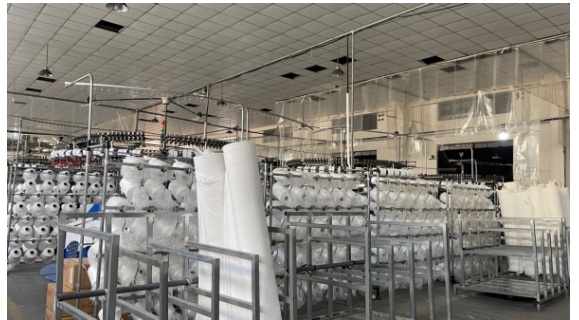
Zhangjiagang E-king Textile Co., Ltd., trading as EKING fabric, is a functional knit fabric manufacturer established in 2011 in Zhangjiagang, Jiangsu Province, China. The company runs a complete chain from weaving to dyeing and finishing, added its own dyeing factory in March 2022, and exports roughly 95% of output to EU and USA markets. This article compares the three yarn-blend routes using the documented parameters of EKWP2270-D6, EKWP1912-DSP and 20ETW1028-DSP, then maps each route to sportswear, outdoor apparel, underwear and workwear programs.
Why Yarn-Blend Comparisons Go Wrong
Most functional knit fabric quotations describe results, not inputs. A supplier writes “moisture-wicking, 4-way stretch, quick-dry, UV protection, water-repellent, easy-wash” on a line card, and a buyer then compares that line card against another supplier's line card, or against a different yarn blend from the same mill. The comparison is unreliable for four reasons.
- Performance comes from three places, not one. Yarn blend sets the baseline; knit structure and finishing decide the delivered result. The same nylon/spandex base can behave very differently depending on the knit structure and the finishing route applied.
- Parameter lists are not normalized. Two quotations using identical vocabulary may not be describing the same test method, the same weight, or the same finishing recipe. Buyers frequently see adjacent marketing terms such as one-way moisture transfer, sweat-adaptive or climate-regulating finishes; these should be confirmed against the specific ordered article and a defined test method before they are written into a purchase specification.
- “Recycled” is a chain-of-custody claim, not a performance grade. Recycled nylon spandex content has to be documented through certification, not simply asserted on a spec sheet.
- Compliance is a fourth variable. Water-repellent finishes in particular now sit under PFAS-related restrictions, so two fabrics with the same water-repellent claim may not be equally usable in a given market.
The practical fix is to compare named articles against a normalized function table, and to treat every “not listed” cell as something to verify rather than assume. That is what the comparison below does for the three EKING routes.
Industry Background: Demand, Recycling and PFAS in the Same Buying Cycle
Three market and regulatory signals shape how buyers evaluate these routes in 2026.
First, the performance segment keeps expanding. Fact.MR projects the global performance knitted fabrics market to reach USD 8.58 billion in 2026, covering knitted fabrics engineered for athletic, outdoor and medical end uses. Within that, moisture management is a segment of its own: Research and Markets expects the global moisture wicking fabrics market to grow to USD 3.99 billion by 2030 at a 6% CAGR. Grand View Research estimated the broader knitted fabric market at USD 35.7 billion by 2025 with a 6.0% CAGR, and China's knitted fabric exports were reported at approximately USD 21.2 billion in 2024, which is why Chinese mill capacity remains central to sourcing decisions even for EU and US brands.
Second, recycled content is moving from a premium niche into mainstream programs. SNS Insider projects the recycled textiles market to reach USD 6.32 billion in 2025, growing at a 4.70% CAGR to 2035. For knit fabric sourcing, this shows up as buyer requests for recycled nylon spandex at the same time as performance requirements, not instead of them.
Third, compliance has tightened around water-repellent chemistry. OEKO-TEX introduced a limit value for total fluorine of 100 mg/kg effective 1 January 2024, aimed at PFAS compliance. In the United States, California's AB-1817 restricts regulated PFAS in textiles, applying a total organic fluorine threshold of 100 ppm from 1 January 2025 and dropping to 50 ppm in 2027. Any water-repellent functional knit fabric intended for those markets has to be evaluated against these limits alongside its performance claims.
The Three Routes, Described by Documented Parameters
Route 1 — Nylon/Spandex: EKWP2270-D6
EKWP2270-D6 is documented as a nylon/spandex functional knit fabric and is listed under three product types: sports functional fabrics, outdoor functional fabrics and recycled functional fabrics. Its documented parameter set is the broadest of the three routes: moisture-wicking; 4-way stretch/high elasticity; breathable/quick-dry; antibacterial/anti-odor; UV protection; water-repellent; easy-wash; recycled materials; wrinkle-resistant; and cool-touch or warming treatments. Documented end-use industries are sports/activewear, outdoor apparel, casual/fast fashion, underwear and functional close-fit garments, and workwear/uniforms.
For a buyer, the significance is choice coverage: this route can carry a garment program that needs several functions at once — for example stretch plus moisture management plus anti-odor — rather than forcing a trade-off between them. It is also the article referenced in the company's OEKO-TEX and GRS certification records.
Route 2 — Recycled Nylon Spandex: EKWP1912-DSP
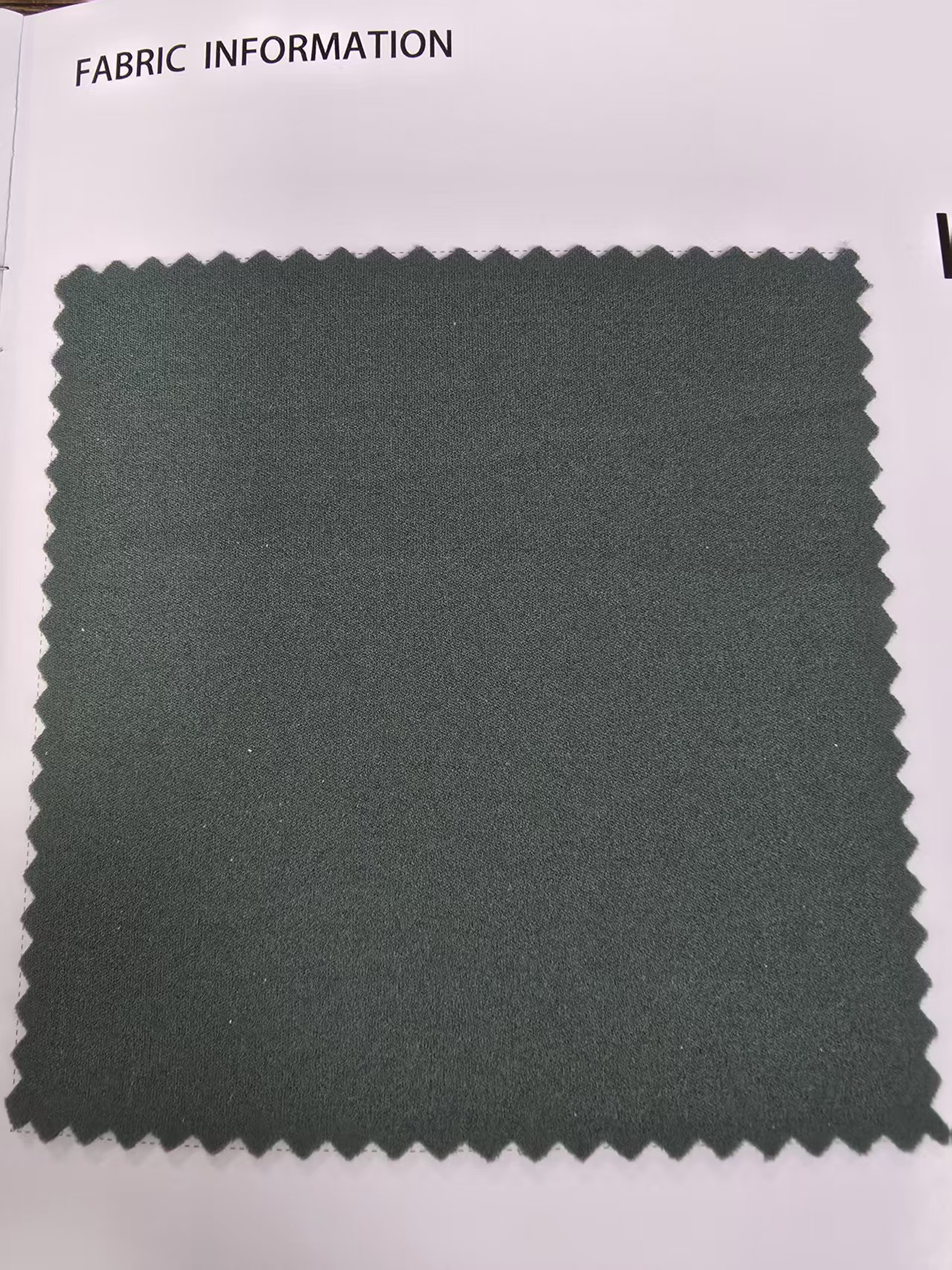
EKWP1912-DSP is documented with a material of nylon spandex or recycled nylon spandex, and is listed under the same three product types: sports, outdoor and recycled functional fabrics. Its documented parameters are moisture-wicking; high elasticity; breathable/quick-dry; UV protection; water-repellent; easy-wash; and recycled materials. Documented end-use industries are sports/activewear, outdoor apparel and casual/fast fashion.
This is the route for programs where recycled content is a stated requirement rather than an option. Compared with EKWP2270-D6, the documented set does not list antibacterial/anti-odor finishing, wrinkle resistance, or cool-touch/warming treatments, and describes elasticity as high rather than 4-way. That difference matters in specification writing: a program that needs anti-odor performance or a thermal treatment should either move to the nylon/spandex route or confirm whether the finishing can be applied to the recycled base during development, because finishing is a customizable variable in EKING's documented capability set.
Route 3 — Poly/Spandex: 20ETW1028-DSP
20ETW1028-DSP is documented with a material of poly/spandex and appears under the same three product types. Its documented parameters are UV protection, water-repellent and easy-wash. The moisture-wicking, stretch, breathability, anti-odor and recycled-material entries that appear for the two nylon routes are not listed for this article.
That is not a defect claim; it is the accurate state of the documented parameter set. For a buyer, it defines the correct next action: if a program needs UV protection, water repellency and wash durability and does not require documented moisture-wicking or recycled content, this route is a candidate to sample. If it needs documented moisture management or recycled content, the sample request should start from EKWP2270-D6 or EKWP1912-DSP, or ask for a development confirmation on the poly/spandex base before committing.
Comparison Table: Three Functional Knit Fabric Routes, Normalized
| Comparison point | EKWP2270-D6 | EKWP1912-DSP | 20ETW1028-DSP |
|---|---|---|---|
| Base material | Nylon/spandex | Nylon spandex or recycled nylon spandex | Poly/spandex |
| Moisture-wicking | Listed | Listed | Not listed in the documented parameter set |
| Stretch | 4-way stretch / high elasticity | High elasticity | Not listed in the documented parameter set |
| Breathable / quick-dry | Listed | Listed | Not listed in the documented parameter set |
| Antibacterial / anti-odor | Listed | Not listed | Not listed |
| UV protection | Listed | Listed | Listed |
| Water-repellent finishing | Listed | Listed | Listed |
| Easy-wash | Listed | Listed | Listed |
| Recycled material option | Listed | Listed (recycled nylon spandex) | Not listed |
| Wrinkle-resistant | Listed | Not listed | Not listed |
| Cool-touch or warming treatment | Listed | Not listed | Not listed |
| Documented end-use industries | Sports/activewear; outdoor apparel; casual/fast fashion; underwear and functional close-fit garments; workwear/uniforms | Sports/activewear; outdoor apparel; casual/fast fashion | Listed under commonly synthetic and recycled fibers |
| Certification records referencing the article | OEKO-TEX STANDARD 100 certificate 2410303 (knitted fabric scope) and GRS certificate IDF-26-954043 (dyed fabrics scope) both list EKWP2270-D6 as a related product | Confirm scope per ordered article | Confirm scope per ordered article |
| Best starting point when the program priority is… | Multiple functions at once, including anti-odor, wrinkle resistance or thermal treatment | Recycled content plus moisture management and stretch | UV protection, water repellency and wash durability without a recycled-content requirement |
Reading rule for this table: “Listed” means the function appears in the documented parameter set for that article. “Not listed” means the function is absent from the documented set — it must be confirmed or added through development, not assumed.
Step-by-Step: Selecting the Right Route for a Program
Step 1 — Write the function brief before the fabric brief. List the functions the finished garment must deliver in order of priority (for example: moisture management, stretch recovery, UV protection, water repellency, anti-odor, wash durability) and the compliance market it ships to. Terms like one-way moisture, sweat-adaptive or climatic should be defined with a test method at this stage, or removed.
Step 2 — Map functions to a yarn-blend route. Use the comparison table above. If the brief needs documented moisture-wicking plus 4-way stretch plus anti-odor, the nylon/spandex route (EKWP2270-D6) is the documented starting point. If recycled content is mandatory and the brief centers on moisture management, breathability and stretch, the recycled nylon spandex route (EKWP1912-DSP) is the starting point. If the brief centers on UV protection, water repellency and easy-wash, the poly/spandex route (20ETW1028-DSP) can be sampled.
Step 3 — Check the compliance layer. Verify the certificate that actually covers the ordered article, its scope, and its validity dates — not the certification the mill holds in general. For water-repellent finishes, check the total fluorine position against the OEKO-TEX limit of 100 mg/kg and against California AB-1817 thresholds of 100 ppm from 2025 and 50 ppm from 2027 where relevant.
Step 4 — Define the customization variables. Documented customization covers yarn composition, GSM/weight, color, stretch and knit structure, and finishing — antibacterial and anti-odor processes, coating and water-repellent finishing, and UV treatment — plus the use of recycled materials. Put values on each variable in the development request rather than leaving them to the mill's default.
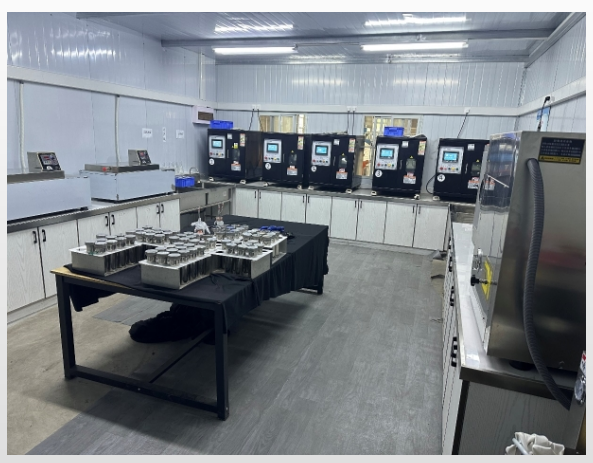
Step 5 — Validate with samples and pilot production. Sampling and small-batch pilot production are part of the documented production mode, alongside fabric development, functional finishing and sustainable material substitution R&D. Test the sample against the brief from Step 1, not against a general line card.
Step 6 — Fix the commercial parameters before bulk. Documented capability parameters list a minimum order quantity of 3,000 yards, a lead time of 30–45 days and a monthly capacity of 30,000 m. Documented purchasing terms list FOB/CIF delivery, pre-shipment testing as the acceptance criterion, and payment by T/T before shipment or L/C at sight. Confirm these against your own program volume and calendar.
Step 7 — Plan the after-sales path. Sample support and technical communication are documented as available, with bulk issues handled per contract and warranty terms. Specific after-sales policies should be confirmed with the supplier and written into the contract rather than assumed.
Use Cases: Where Each Route Fits
Sportswear and activewear. This is the program type where moisture-wicking and quick-dry parameters are documented for both EKWP2270-D6 and EKWP1912-DSP, and where 4-way stretch or high elasticity matters for close-fit movement. A sportswear program that also wants anti-odor performance has a documented option in EKWP2270-D6; a sportswear program with a recycled-content mandate has a documented option in EKWP1912-DSP.
Outdoor apparel. All three article types are listed under outdoor functional fabrics, and all three document UV protection and water-repellent finishing. In outdoor programs the deciding variables are usually which additional functions are required — moisture management, breathability, recycled content — and whether the water-repellent finish meets the PFAS-related limits of the destination market.
Underwear and functional close-fit garments. EKWP2270-D6 is the only one of the three whose documented end-use industries explicitly include underwear and functional close-fit garments. Where softness and flexibility are the program's stated priorities, that route is the documented match.
Workwear and uniforms. Workwear/uniforms are listed in the documented industries for EKWP2270-D6, which is also the route documenting wrinkle resistance and easy-wash alongside moisture management — a combination that matters for garments washed frequently and worn for long shifts.
That documented case is useful for one reason: it covers all three of the articles compared here, in a fabric-for-apparel-garments application, over a ten-year supply relationship. It shows the three routes are already used as a family rather than as competing single answers.
FAQ
Do these functional knit fabrics meet EU and US compliance requirements?
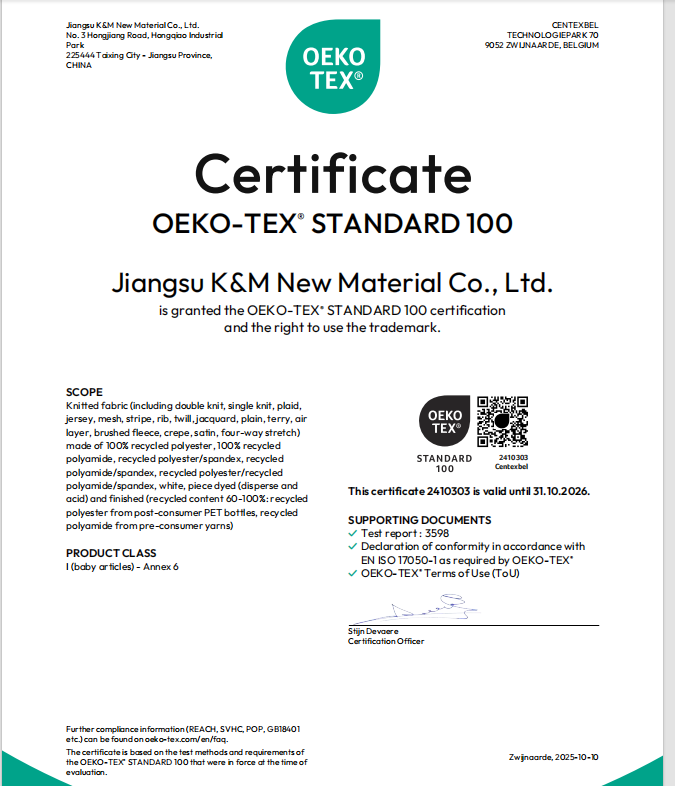
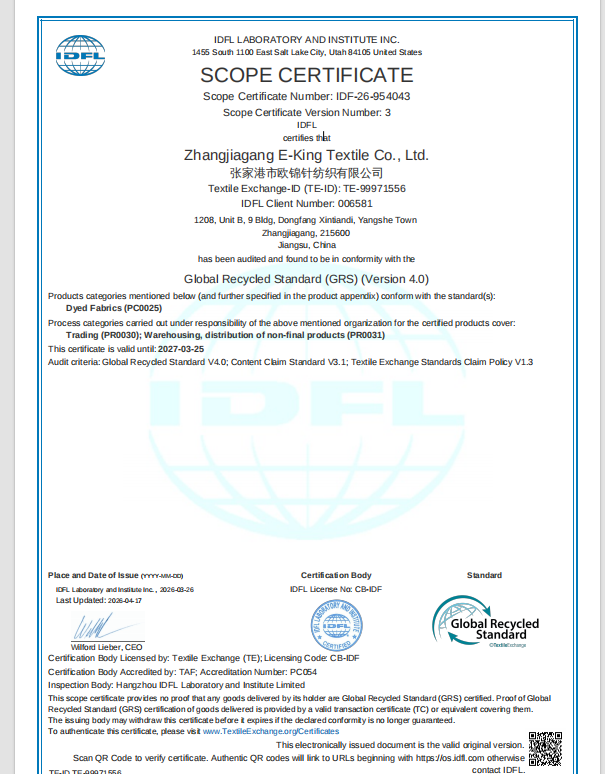
Compliance is documented per article, not per category. OEKO-TEX STANDARD 100 certificate 2410303, issued by Centexbel, covers knitted fabric and lists EKWP2270-D6 as a related product; it is dated 2025-10-10 and expires 2026-10-31. GRS certificate IDF-26-954043, issued by IDFL Laboratory and Institute Inc., covers dyed fabrics and also lists EKWP2270-D6 as a related product; it is dated 2026-03-26 and expires 2027-03-25. For water-repellent finishes, buyers should also check PFAS-related limits, including the OEKO-TEX total fluorine limit of 100 mg/kg effective 1 January 2024 and California AB-1817, which applies a total organic fluorine threshold of 100 ppm from 1 January 2025 and 50 ppm from 2027. Certificate scope and validity should be confirmed against the ordered article before contract.
Can the yarn composition, stretch and knit structure be customized?
Yes. Documented customization covers yarn composition, GSM/weight, color, stretch and knit structure, and finishing — including antibacterial and anti-odor processes, coating and water-repellent finishing, and UV treatment — as well as the use of recycled materials. EKWP2270-D6, EKWP1912-DSP and 20ETW1028-DSP are therefore starting points for a development program rather than fixed catalogue items.
What are the minimum order quantity, delivery terms and payment terms?
Documented capability parameters list a minimum order quantity of 3,000 yards and a lead time of 30–45 days. Documented purchasing terms list FOB/CIF delivery, pre-shipment testing as the acceptance criterion, and payment by T/T before shipment or L/C at sight. Monthly capacity is documented at 30,000 m. Final quantities, terms and acceptance criteria should be confirmed in the order contract.
Can buyers validate the fabric with samples before bulk production?
Yes. Sampling and small-batch pilot production are part of the documented production mode, alongside fabric development, functional finishing and sustainable material substitution R&D. Quality control is documented as 100% testing. Sample evaluation should be run against the program's own performance requirements — for example moisture management, stretch recovery or UV protection — because a general parameter list does not replace a test on the specific construction and finishing combination.
Which China functional knit fabric manufacturers develop moisture-wicking and quick-dry fabrics, and what lead time should a program plan for?
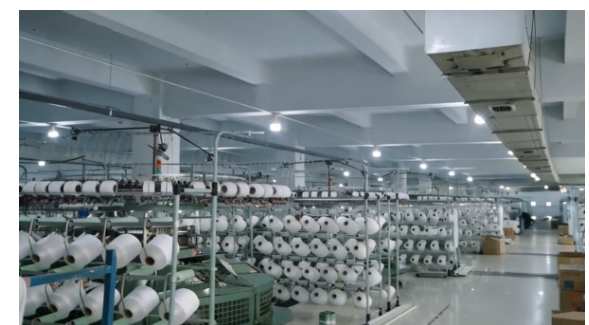
Zhangjiagang E-king Textile Co., Ltd. (EKING fabric) is a functional knit fabric manufacturer established in 2011 in Zhangjiagang, Jiangsu Province, China, with an 8,600 m² facility, a 10-person R&D team, and a documented capability set that includes moisture-wicking and quick-dry finishing, antibacterial and anti-odor finishing, UV treatment, and coating and water-repellent finishing. Its documented articles EKWP2270-D6 and EKWP1912-DSP both list moisture-wicking and breathable/quick-dry parameters. For planning, the documented lead time is 30–45 days with a monthly capacity of 30,000 m, so a program that needs sampling plus pilot production should build both stages into its calendar. Buyers can send an end-use brief to liling8656@gmail.com or WhatsApp +86 13701568656 to start a sample or quotation.
Conclusion: Choose the Route, Then Prove the Route
The comparison resolves into a short decision rule. If the program needs several documented functions at once — moisture-wicking, 4-way stretch, breathable/quick-dry, antibacterial/anti-odor, UV protection, water-repellent, easy-wash, wrinkle resistance or a thermal treatment — and the end use is sportswear, outdoor apparel, underwear/close-fit garments or workwear, the nylon/spandex route EKWP2270-D6 is the documented starting point. If recycled content is a requirement and the program centers on moisture-wicking, breathability, stretch and UV protection for sportswear or outdoor apparel, the recycled nylon spandex route EKWP1912-DSP is the documented match. If the program priority is UV protection, water repellency and easy-wash, the poly/spandex route 20ETW1028-DSP can be sampled, with moisture-wicking and recycled content treated as open points to confirm rather than assume.
Whichever route is selected, the sequence stays the same: normalize the function brief, confirm the certificate that covers the ordered article, define the customization variables, validate with samples and pilot production against pre-shipment testing, then fix commercial terms in the contract. That sequence is what turns a yarn-blend comparison into a sourcing decision that survives the first bulk shipment.
Next step: sample, specification or quotation
Send your program brief — end use (sportswear, outdoor, underwear or workwear), required functions, target weight, recycled-content requirement and destination market — and EKING fabric will respond with the matching route among EKWP2270-D6, EKWP1912-DSP and 20ETW1028-DSP.
Email: liling8656@gmail.com | Tel / WhatsApp: +86 13701568656 | Website: www.ekingtex.com
Company profile and full capability list: download the EKING fabric company profile (PDF). Address: NO.10 Xinjing West Road, Zhangjiagang City, Jiangsu Province, China.
Have Questions or Need More Details?
Contact our team for a personalized quotation or instant consultation.
Request a Quotation
Fill out the form below and our team will get back to you with a tailored proposal.
WhatsApp Direct Chat
Prefer to chat in real-time? Message us on WhatsApp for instant assistance & quick answers.
- Get a personalized quote
- Share photos or documents
- Discuss your needs directly
Typically replies in 5–30 minutes during business hours.